At the 2010 World Cup, England's Frank Lampard hit a shot that clipped the crossbar, bounced over the goal line, and spun back out. Millions of people watching at home could see it was a goal. The referee couldn't, and the goal didn't count.
Nobody did anything wrong. The ball moved faster than anyone on the field could follow, from an angle that hid it. The moments that decide sport are often too fast, too close, or too subtle to see. For roughly a century, sports have been adding tools designed to make those moments easier to observe, review, and explain.
Quick answer
Sports officiating technology has evolved from photo finishes and TV replay to goal-line technology, video review, and electronic line calling. Many of these systems improve precision by focusing on a clearly defined decision, and many rely on specialized cameras, sensors, or dedicated review operations. Each sport's rules define how the technology informs a call. The newest generation, Live Video Intelligence, turns live video from any camera into objective, structured measurement the moment it happens. OWL informs; the official makes the call.
Where Did Officiating Technology Start?
Officiating technology started at the finish line. Photo-finish cameras came into use in horse racing and athletics in the early to mid 20th century to separate competitors crossing the line almost together. It was one of the first times sports relied on a recorded image to see something a person couldn't.
Television replay arrived in 1963, when CBS used instant replay for the first time during the Army-Navy football game. It wasn't built for officials. It was built for fans, as a way to show a play again. For years, the people at home often had a better view of close calls than the people making them.
When Did Replay Become Part of the Rules?
Replay became part of the rules in the NFL in 1986, when the league adopted a limited replay review system. That system stayed in place through 1991 and was then dropped. Replay returned in 1999 with the coach's challenge.
Getting to 1986 took a while. The NFL first experimented with replay in the 1970s, but the program was dismissed, in part because of the expense of installing extra cameras in every stadium. Infrastructure has shaped officiating technology from the start.
The back-and-forth reflects a tension many sports have felt. Leagues want the right call, but they also worry about delays and about undermining officials on the field.
Why Did Football Finally Adopt Goal-Line Technology?
Football adopted goal-line technology after high-profile missed calls, including Lampard's disallowed goal at the 2010 World Cup. The International Football Association Board (IFAB) approved the technology in July 2012, and it was used at a World Cup for the first time in 2014. The first World Cup goal it awarded came in France's win over Honduras that June.
The question it answers is narrow: did the whole ball cross the whole line? An approved system detects that event and sends a signal to the referee.
That narrowness likely helped its acceptance. When the question is purely physical and everyone agrees on what counts, technology can answer it cleanly, and there is less room for debate about the result.
Does More Video Review Mean More Certainty?
More video review doesn't automatically mean more certainty. Review systems let officials check key decisions against recorded footage, but two people can watch the same slow-motion angle and still disagree, especially on judgment calls like contact or intent.
Cricket first trialed its Decision Review System (DRS) in 2008. Football's rule-makers voted in March 2018 to add the video assistant referee (VAR) to the laws of the game, clearing the way for its use at that summer's World Cup. Unlike goal-line technology, these systems often support judgment-dependent decisions, not just physical measurements.
What review shows is that more footage isn't the same thing as more evidence. The footage still has to answer a specific question.
Why Hasn't Electronic Line Calling Spread to Every Sport?
Electronic line calling hasn't spread to every sport for several reasons. Cost and infrastructure are important barriers, alongside sport-specific rules, camera geometry, playing conditions, and league workflow. That puts it out of reach for many leagues, tours, and events.
Where it has been adopted, the shift has been significant. Tennis introduced a player challenge system backed by ball-tracking in 2006. The US Open used electronic line calling on all but its two main stadium courts in 2020, the Australian Open became the first major to remove line judges from every court in 2021, and Wimbledon did the same in 2025.
How Have the Generations Compared?
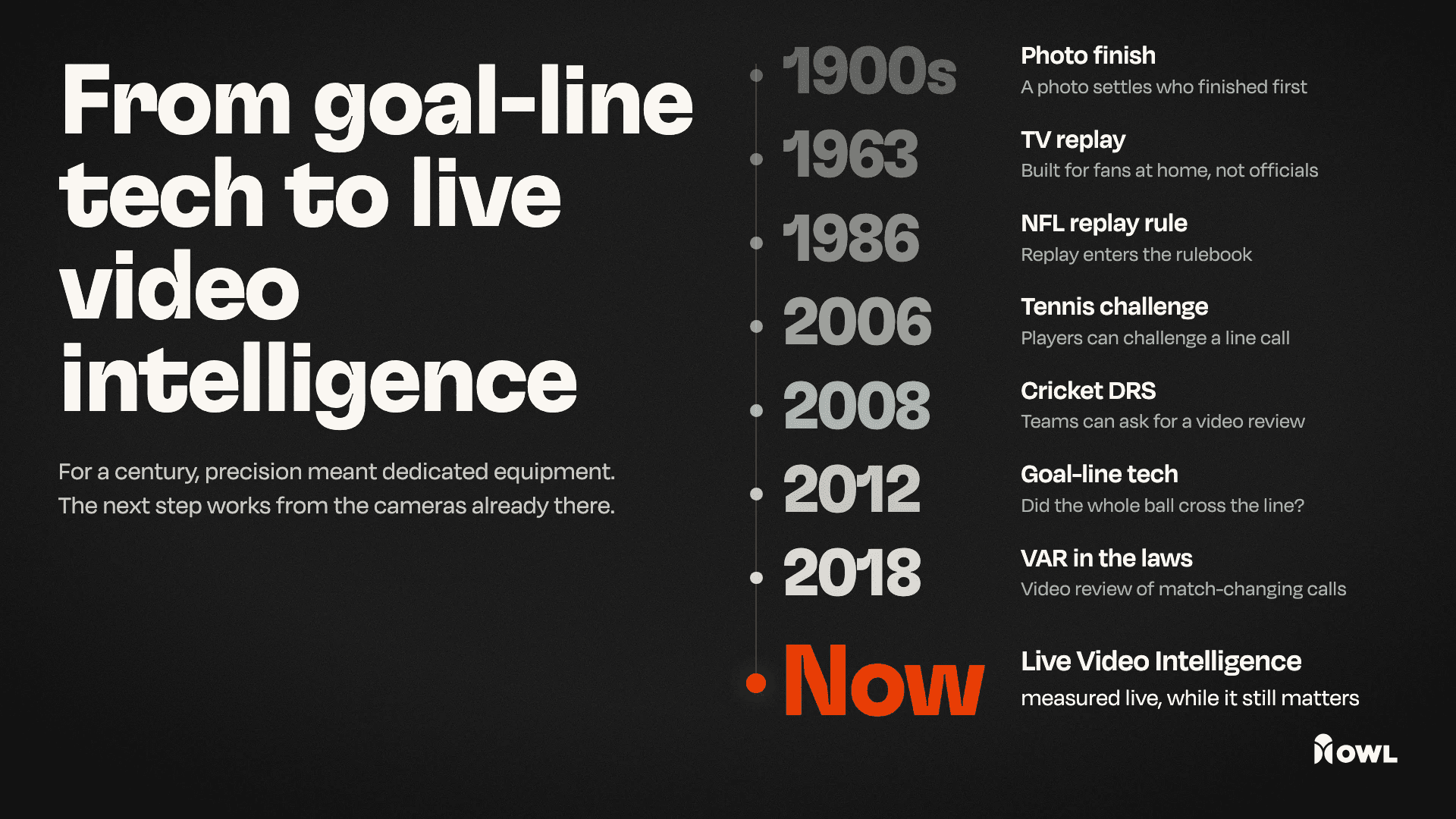
Each generation of officiating technology changed what could be seen, and each fit into the sport's rules differently. Some provide evidence for officials to review. Others automatically signal a defined event. Here's how they line up:
What Comes After Specialized Hardware?
The next step is Live Video Intelligence. From any camera, OWL turns live video into objective, structured measurement the moment it happens. That brings measurement that used to require broadcast-scale infrastructure to leagues, tours, and events at every level, not just the ones with the biggest budgets.
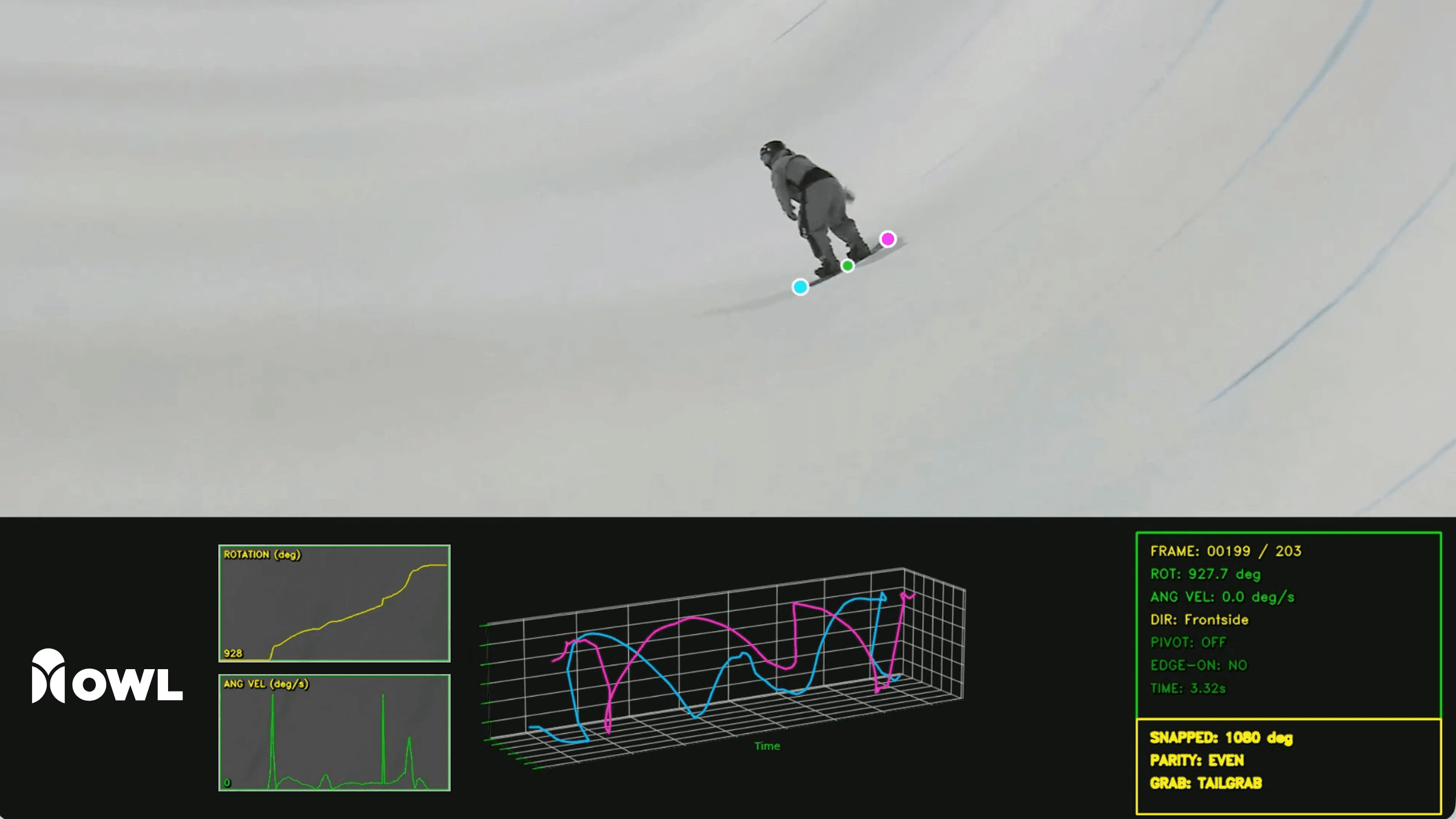
It's already live. OWL delivered live reads during a pro snowboard superpipe final broadcast at X Games Aspen in January 2025, provides live line-call officiating for Major League Pickleball, and delivers real-time, broadcast-ready dunk metrics for Dunkman on TNT.
The point isn't more statistics. It's a better story. The same measurement that gives an official clear evidence can help the broadcast explain what just happened while it still matters, instead of leaving fans to argue about it for days.
The discipline from earlier generations still applies. Every measurement has to be clearly defined and shown with the evidence behind it, so anyone with a stake in the outcome can check it. To go deeper, read Live Video Intelligence, Explained.
What Can Leagues Learn From This History?
This history suggests three useful principles for leagues evaluating officiating technology. Define the decision the technology supports, make the evidence visible, and be clear about how the rules assign authority.
Define the decision. Goal-line technology works on a single, physical question. Broader review systems have to handle more judgment, which invites more debate.
Show the evidence. Tennis made ball-tracking visible to players and fans, which helped build familiarity with it over time.
Be clear about authority. Everyone should know whether technology signals a decision or informs an official, and what happens when the footage isn't clear enough.
Frequently Asked Questions
What Is Goal-Line Technology?
It's a system used in football to detect whether the whole ball has crossed the goal line and automatically alert the referee. IFAB approved it in 2012, and it was first used at a World Cup in 2014.
Is Goal-Line Technology the Same as VAR?
No. Goal-line technology answers one physical question about the ball and the line. VAR is a review process in which officials check footage of certain match-changing decisions, including judgment calls.
What's the Difference Between Replay and Video Review?
Replay means showing a moment again, originally for TV audiences. Video review is a formal process written into a sport's rules, where officials use footage to check a specific decision.
Why Doesn't Every Sport Use Goal-Line Technology or Electronic Line Calling?
Cost and infrastructure are major factors, along with each sport's rules, camera angles, playing conditions, and how its officiating workflow runs.
What Is Live Video Intelligence?
It's OWL's approach to turning live video from any camera into objective, structured measurement the moment it happens. Officials get clear evidence when the call is being made, and broadcasters get context they can use while the moment is live. See how Officiate works for leagues.
Does Officiating Technology Replace Officials?
Usually, no. Most officiating technology makes key moments easier to observe and review, and each sport's rules define its role. OWL is built to inform: it never overrules or grades an official, and the official makes the call.
Want to see how this could work for your league? Explore Officiate for officials and leagues, or talk to the OWL team.