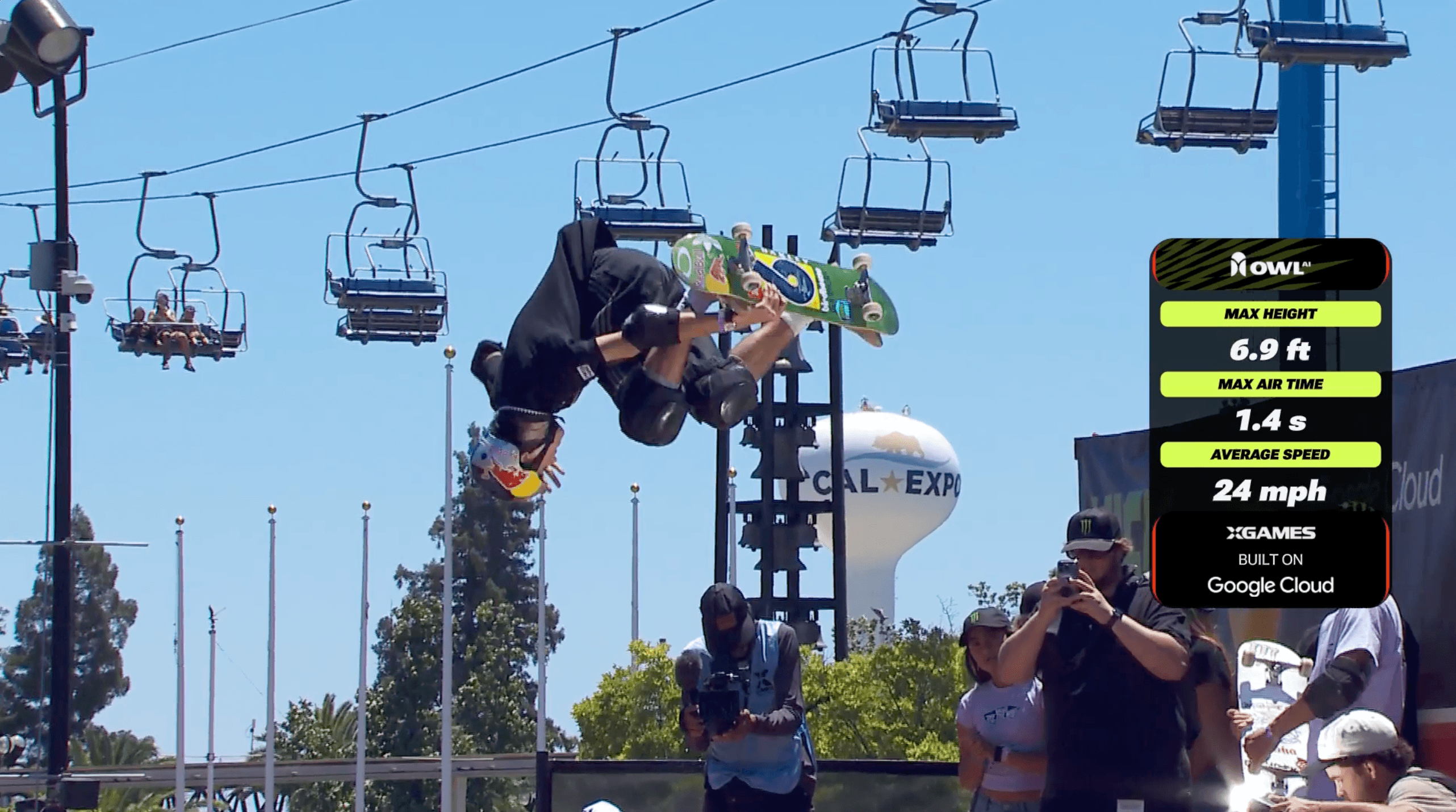
Live Video Intelligence uses computer vision to turn live sports video into measurable facts while the event is unfolding. It helps people understand where a ball landed, how an athlete moved, or what happened in a moment that passed too quickly to follow. Officials use that evidence within their review process. Broadcast teams use it to explain the action to viewers.
It is a specific application of AI in sports: reading what happens in video and making the relevant information available during competition. Sports video analysis software also supports work after an event, such as reviewing performance and organizing clips. Live Video Intelligence focuses on the questions that need attention while play is still moving. People remain responsible for applying the rules and interpreting what the measurements mean.
What problem does Live Video Intelligence solve?
A ball lands near a line. A skateboarder turns above the ramp. Everyone sees the action, but the detail they want to understand may occupy only a few frames.
Replay gives us another look. Sometimes that is enough. In other moments, watching the same footage again leaves the same question unanswered: where, exactly, did the ball land? How did the athlete move between takeoff and landing? Which part of the sequence explains what we just saw?
Live Video Intelligence helps make those details readable. It connects an observation or measurement to the footage behind it, so an official can review the evidence or a commentator can explain it. The value lies in answering a particular question well.
Those questions differ by audience. An official may need a ball's position relative to a boundary. A producer may need a visual explanation of an athlete's movement. A fan may want to understand why a moment looked so different from the one before it. Each needs information presented for the job at hand.
For OWL, that is the purpose of a live video read: help the person watching understand more of what happened, in time to use it.
Where does Live Video Intelligence fit within AI in sports?
AI in sports describes a broad range of uses. Here, the focus is computer vision: analyzing images and video to identify observable details such as position and movement. Live Video Intelligence applies that work to the pace and practical needs of a sporting event.
That distinction helps when evaluating a product. A tool that organizes clips for tomorrow's coaching review has a different job from one that supplies information during an active challenge. A broadcast explanation has another audience again. The shared use of video does not make their requirements interchangeable.
For a league or broadcaster, start with the question a person needs answered. Then establish what the video can show, how the answer will be checked, and when it must arrive. This makes an AI discussion concrete enough to evaluate.
It also sets a boundary around the claim. A system that measures a ball's position has not thereby demonstrated that it can evaluate the difficulty of a routine. Every new use needs evidence appropriate to that sport and task. A convincing demonstration should show both what the system can establish and where its answer stops.
What can computer vision measure from sports video?
Computer vision for sports can analyze position, motion, timing, and relationships between objects across video frames. Which measurements are defensible depends on the footage, the sport, and the system used to interpret it.
Useful questions include:
Where is the ball, athlete, or equipment in the relevant frames?
How does that position relate to a line, boundary, or another object?
What changes between the start and end of a movement?
Can the footage support a measurement of height, distance, speed, rotation, or airtime?
Can the person reviewing the result inspect the video that supports it?
These are questions to test, not a promise that every camera feed can answer all of them. A partially hidden ball or an unsuitable angle can limit what the footage supports. Precision needs to be established for the actual setup and use case.
The explanation matters as much as the number. A height measurement needs a defined reference. A timing measurement needs a clear start and end. A position needs context within the playing area. Without those details, viewers can read the result without understanding what was measured.
A real use case: line-call review
Major League Pickleball's December 2025 partnership announcement described plans to use OWL technology for automatic line calling and its in-match challenge system during the 2026 season, working alongside the league's match referees.
The task is specific: give referees useful evidence about a close ball-to-line relationship within the match review process. That is a practical starting point for understanding what live video analysis can contribute.
Consider a hypothetical close bounce. The useful explanation would identify the relevant moment, show the ball's relationship to the line, and give the official evidence they can inspect within the competition's review procedure. The official then applies the competition’s rules to the evidence.
How does a live video read become useful evidence?
A live video read becomes a structured fact through a four-step workflow: define the specific physical question, identify the supporting footage, convert that footage into a measurement or relationship, then hand the result to the person who applies rules or judgment. Each step keeps the read traceable back to the original video.
Define the question. Decide which observable detail matters. A ball's position relative to a line is a different question from the quality of an athlete's execution. Being specific prevents a measurement from carrying a conclusion it cannot support.
Identify the supporting footage. Establish which frames, views, and scene details are relevant. The evidence should fit the question. An attractive replay angle is not automatically the best angle for a measurement.
Make the read inspectable. Present the measured position, movement, or relationship with enough context for someone to understand it. Keep the connection to the original footage clear, including any limits on what can be established.
Put it into the working process. Give the information to the official, analyst, or producer in a form they can use. The review procedure or broadcast decision determines what happens next.
A demonstration should let the buyer follow that chain. Showing a finished graphic alone leaves too much unexplained. Ask to see the source moment and how the result relates to it, including a difficult example where the footage provides less information.
That is also how a team can distinguish a useful measurement from visual decoration. A line, marker, or number earns its place when it helps someone answer the original question.
Why does real-time sports video analysis need a different workflow?
“Live” changes the problem because sports decisions have a closing window: an explanation is only useful if it arrives while the moment can still be reviewed, explained, or acted on. Live Video Intelligence is built around that window, not around technical speed for its own sake.
During a challenge, officials work within a defined review process. In a production booth, the analyst and producer have to decide whether an explanation belongs in the current sequence or a later replay. A detailed result can be valuable and still arrive too late for either job.
This makes delivery part of the product requirement. Buyers need to know when the footage becomes available, when the analysis can be inspected, and how it reaches the person using it. A generic claim of speed does not answer those questions.
The same is true of presentation. An official needs the evidence relevant to the review. A commentator needs context they can understand and explain on air. Giving both people the same dense display can make the result harder to use.
Evaluate the full sequence under conditions that resemble the intended event. Include the handoff between people, the time needed to check the result, and the fallback when the evidence is incomplete. The meaningful test is whether the information arrives in a usable form before that opportunity passes.
How does it differ from replay and sports video analysis software?
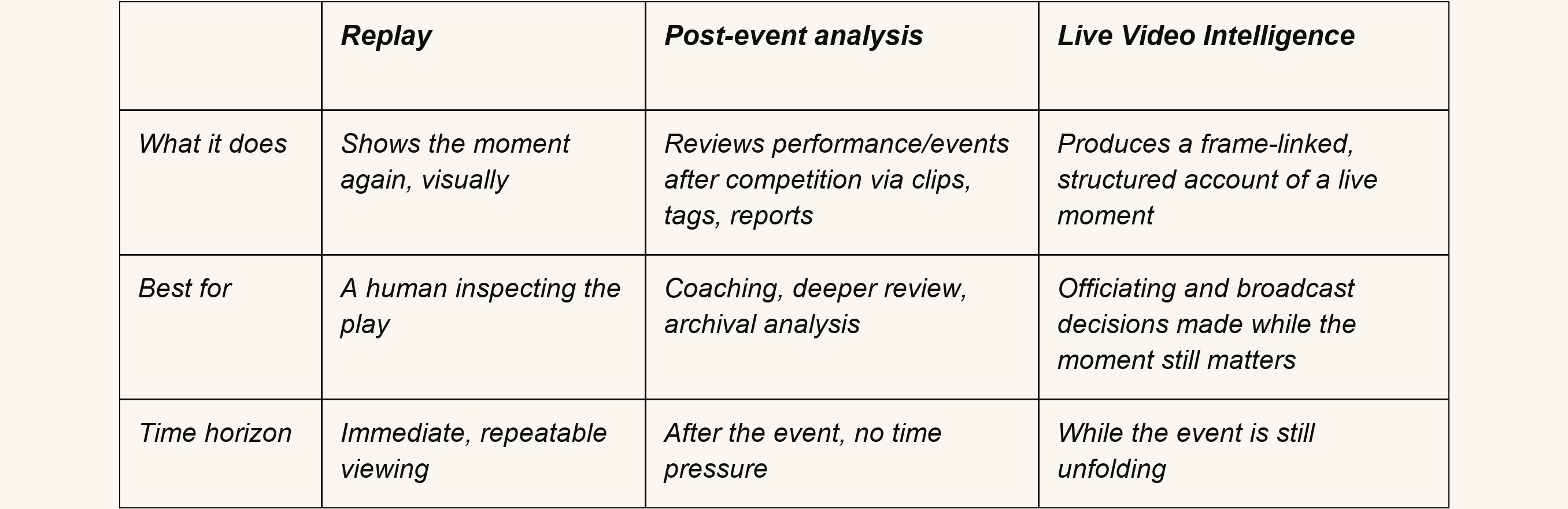
Replay, sports video analysis software, and Live Video Intelligence can complement each other. Their roles overlap, and individual products vary, so it helps to compare the work being done rather than draw an absolute boundary around each label.
Replay lets someone revisit the action. Another view or a slower sequence may reveal the detail they need to inspect.
Sports video analysis software can support tasks such as clipping, tagging, performance review, and reporting. Many of these workflows serve preparation or analysis after competition; some tools also support live work.
Live Video Intelligence focuses on extracting relevant measurements and context from video during the event, with a clear connection between the result and the footage.
A team might use all three around the same play. The live read supports an immediate explanation, the replay lets the audience see it, and the recorded material supports a more detailed review later.
For buyers comparing sports video analysis software, the practical questions are timing, evidence, and fit. Does the tool support the task you actually need? Can someone inspect its output? Does it work within your existing review or production process? Those answers are more useful than a feature list detached from the event.
What remains human?
People retain responsibility for interpreting evidence, applying rules, and communicating decisions. A measurement gives officials information about a physical detail; the sport determines how that information should be used.
This is particularly important in judged sports. Height, rotation, or airtime can help explain a performance. None, on its own, accounts for everything a judge considers. Difficulty, execution, style, and the rules of the discipline require context that a single measurement cannot supply.
Broadcast has its own responsibilities. A producer chooses the story and the pictures. A commentator decides how to explain the detail to an audience. Good information supports those choices without pretending that a number is a complete account of the athlete's performance.
OWL's product overview describes two uses: Officiate supports officials and leagues with review evidence; Analyst supports broadcast teams with live visual information and commentary context. They serve different people, even when both begin with the same sporting moment.
The human role should be clear in the interface and the operating procedure. Everyone involved should know who reviews the information, who has decision authority, and what to do when the footage cannot support a confident read.
What should a league or broadcaster evaluate?
Start with a real event scenario and the person who needs help. Use it to test the whole process, including the less convenient moments that a polished demonstration might leave out.
The task. Name the decision or explanation the tool will support. Agree on what a useful result looks like before comparing features.
The evidence. Ask which footage supports the read and how the reviewer can inspect it. Request examples that show the system's limits as well as its strengths.
The measurement. Establish exactly what is being measured and how it is validated. An accuracy claim needs a defined test, relevant conditions, and a clear account of errors.
The timing. Set the window in which the result must be available. Evaluate the complete process from capture through review and delivery, including the steps performed by people.
The handoff. Check that the output fits the official's procedure or the production team's tools. Establish who receives it, checks it, and decides whether to use it.
The fallback. Decide what happens when footage is missing, a view is obstructed, or the result is inconclusive. A responsible workflow makes those conditions visible.
The record. Agree on what will be retained for later review and who can access it. That record should let the team investigate a disputed result or improve the process after the event.
These questions make the evaluation specific enough for product, engineering, and the people running the event to discuss together. They also keep a strong result in one setting from becoming an unsupported promise about every sport.
Frequently asked questions
What is Live Video Intelligence in sports?
Live Video Intelligence uses computer vision to turn sports video into measurements and context during an event. It helps officials review observable details and broadcast teams explain the action, while people retain responsibility for decisions and interpretation.
How is it an application of AI in sports?
It applies computer vision to the footage of a sporting event. The purpose is to identify relevant physical details and make them useful within a live review or broadcast process. Each capability needs evidence for the sport and setup where it will be used.
Is Live Video Intelligence the same as instant replay?
No. Replay shows the action again. Live Video Intelligence adds measurements or context drawn from the footage. The two can work together, with the replay showing the moment and the analysis helping explain a specific detail.
Is it the same as sports video analysis software?
The categories overlap. Sports video analysis software covers a range of tasks, including clips, tagging, and performance review. Live Video Intelligence emphasizes the measurements and explanations needed during competition. Compare products by their actual capabilities and workflow.
Does it replace officials or judges?
No. It supports people with evidence from video. Officials and judges remain responsible for applying the sport's rules and interpreting the performance in context. A physical measurement should not be presented as a complete judgment of an athlete's performance.
Can any camera feed produce a reliable measurement?
Do not assume so. The footage and the measurement method must support the particular question. Ask the provider to demonstrate the intended setup, explain its limitations, and show how uncertain or incomplete results are handled.
What should a buyer ask before adopting Live Video Intelligence?
Start with the moment and the user: what question needs to be answered, what evidence is available in the video, who will use the read, and how will human authority remain clear? A useful deployment is tied to a specific workflow, not an abstract promise of automation. If you’re evaluating this for your own broadcast or officiating workflow, see how Officiate applies these questions in practice.
How does OWL put this to work?
The value of a live read is straightforward: someone understands a moment more clearly while there is still time to review it or explain it. That standard keeps the work tied to sport and the people who make it happen.
Explore Officiate for officials and leagues, or Analyst for broadcast teams. Ready to see it applied to your league or broadcast? Get in touch with the OWL team.