Chris Haire spent nearly six years at EA Sports' Tiburon studio, the home of Madden and NCAA Football. He was lead programmer on three NCAA Football titles and worked on the gameplay team that wrote the logic deciding how each computer-controlled player read the play and moved. At Zwift, where he ran engineering, he worked on races where real cyclists, pedaling at home, competed in a virtual world. At OWL he now works out what happened in a real, live game from the video of it.
Much of that experience carries over: physics, motion, and how athletes make decisions. The big difference is where the truth comes from. In a video game, the code knows where everything is. In a live game, the only evidence is what the camera shows. "If you're building a simulation… you can retrace the decision-making that a computer made, that simulated player made," said Haire, who became OWL's chief technology officer in September. "With humans, you can't. So you have to just go off of what you see as evidence of what really happened in real life."
What Changes When a Computer Watches a Real Game?
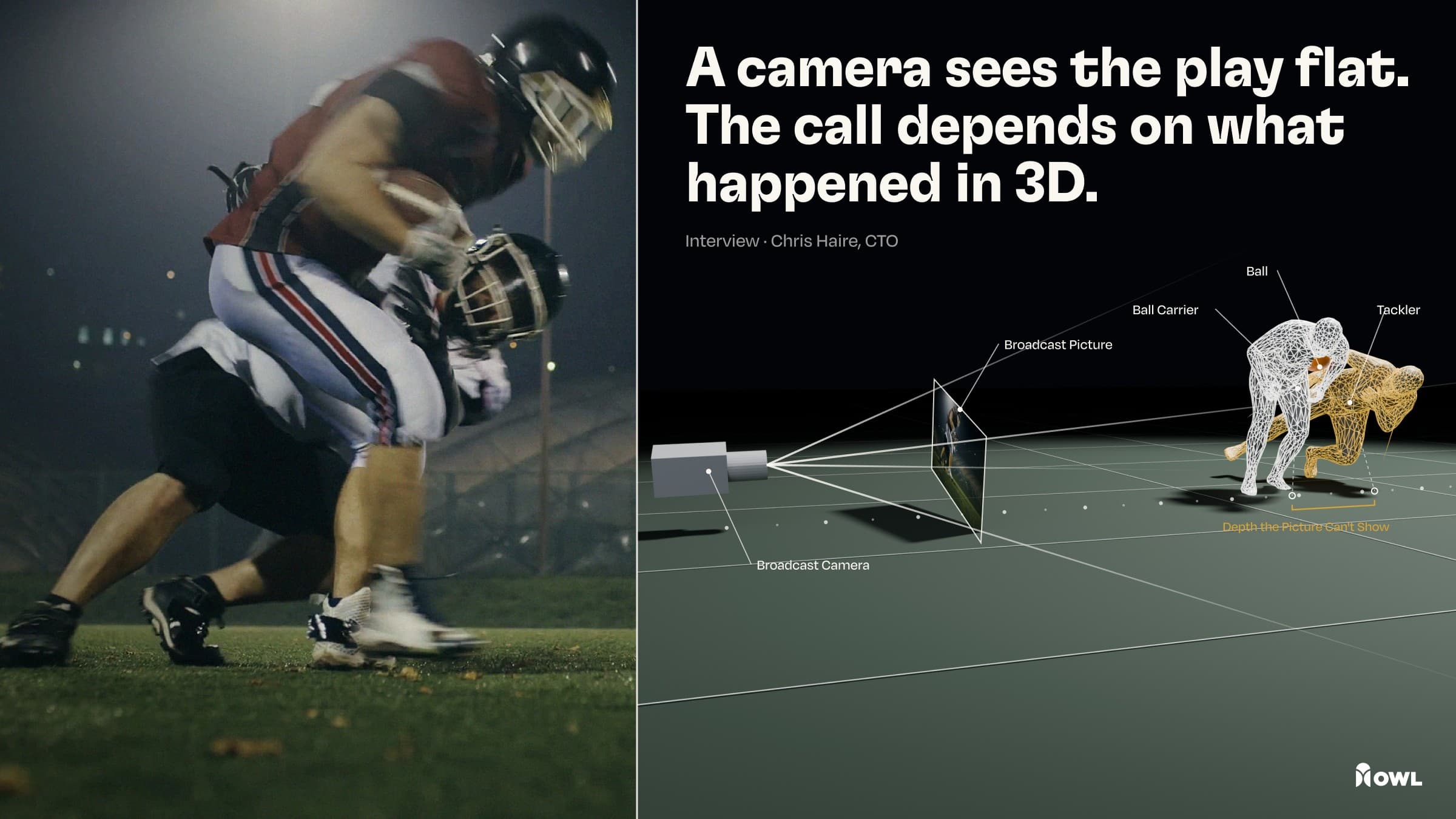
In a video game, the code decides where the ball goes, so the game always knows where it is. In a real game, the system only has what the camera shows, and the ball can be hidden behind a player or leave the frame. Haire's starting point is one every game developer knows: each view in a sports game is a camera placed inside a simulated world.
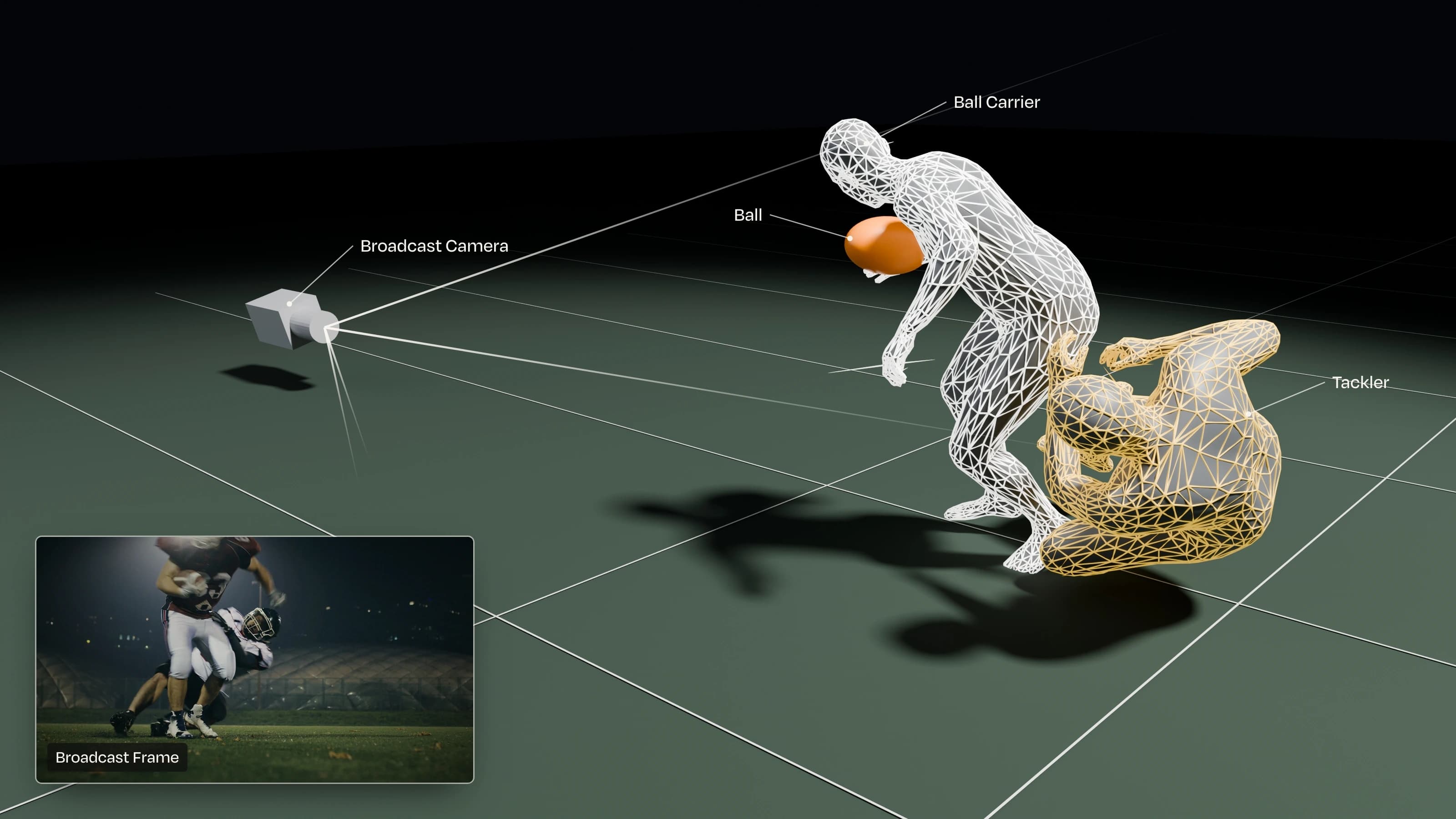
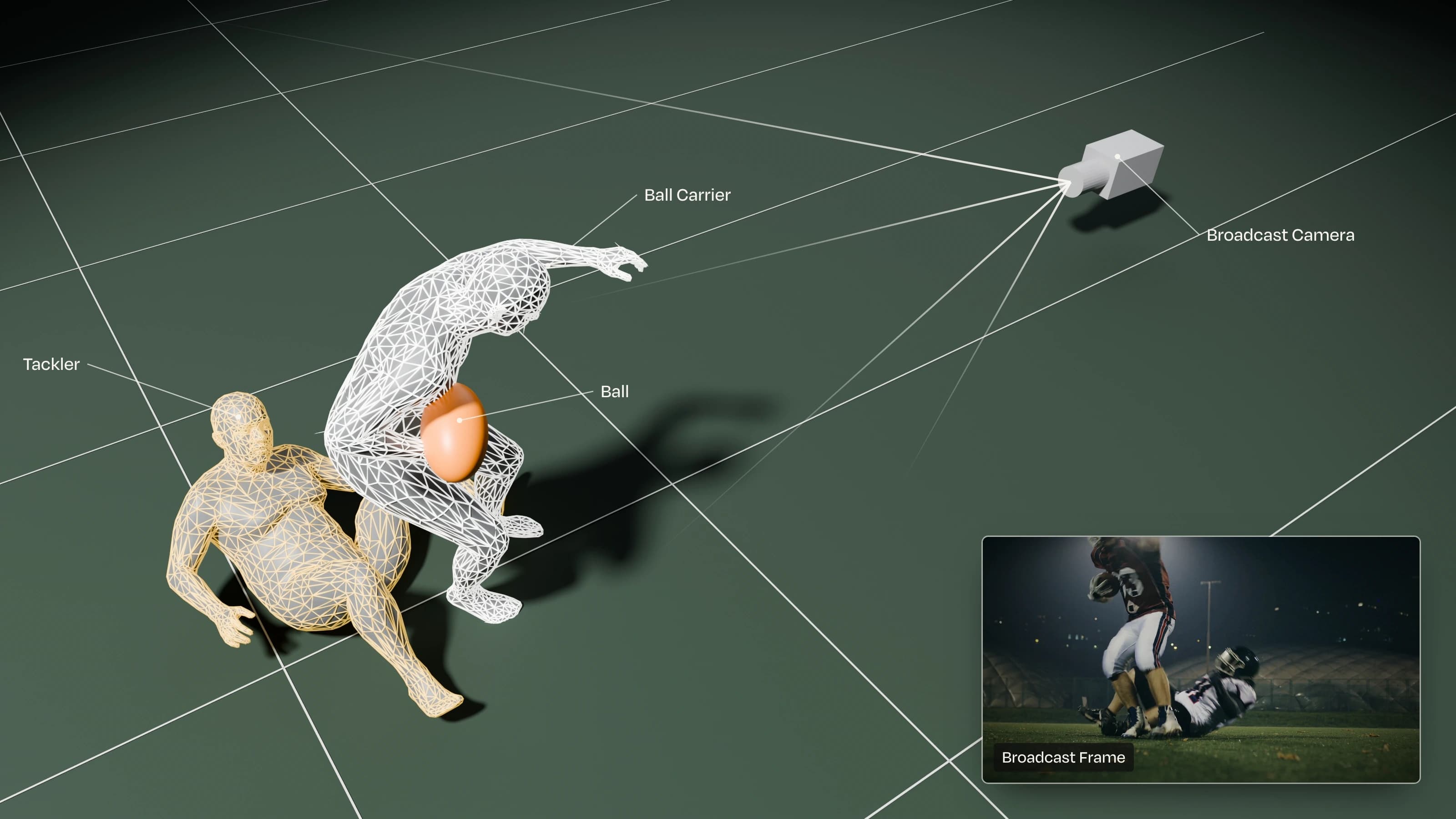
"In the football game, all the different positions you're seeing is literally a camera with a view of the world," he said. "You're trying to translate what you're seeing in the cameras and show what real life would look like."
Real footage is the same idea in reverse. The camera angle decides how much one view can tell you about the ball. "If you're looking dead on at a football coming towards a camera, it's really hard to determine the distance and the speed," he said. "If it's at a slight angle, it's easier. If you're completely perpendicular, then it's really easy to determine the distance and speed… the arc and parabola, and even predict where it's going to be."
When the ball disappears behind a player, physics fills in part of what the camera missed. "You can understand what was happening before the occlusion happened and simulate what's probably going to happen after," Haire said. "And then if it doesn't happen, you can probably detect that something happened when the ball was occluded that changed the normal physics and trajectory of the ball." A second camera angle can show what the ball hit, and with only one angle the system can still tell that its path changed.
Why Can't You Retrace a Real Athlete's Decision?
In a video game, every player's decision comes from logic a developer wrote. On NCAA Football, Haire's team built separate decision logic for each position, from cornerbacks and safeties to the quarterback working through his reads.
"Our motto at EA Sports was, if it's in the game, it's in the game," he said. "All the human behavior and decision-making was coded into the logic of each one of those players and non-players that make the sport real." Even the motion was real: the team motion-captured football players and turned that data into the animations players saw on screen.
There is no code to inspect for a real athlete. The moments that decide games often come down to intent, such as whether a foul was deliberate, and intent has to be read from the evidence on video. Haire pointed to a World Cup red card that can look deliberate in slow motion and accidental at full speed. "How do you make those calls? It's tough, but that's our job," he said, "to do the tough work and get the evidence there, looking at both the live video that's happening and training off of archives of data."
How Did Video Games Handle Officiating, and What Does OWL Do Differently?
The referees in EA's football games were simulated too. The games ran AI officials that watched each play and threw flags, and the developers added a little randomness on purpose.
"There's even a little bit of randomness thrown in there to simulate that we as humans get things wrong," he said. "In our mission with OWL, we're trying to get it right and take some of the human bias out. So it's kind of like the inverse."
Haire sees that work as support for officials, not a replacement for them. "I don't think the officials even want to get it wrong," Haire said. "The work that we're doing just helps an official get to the right call at the end of the day and support their call, and allow the fans to understand why the call was made." He added that the reasoning behind calls has often been "a black box and opaque to players."
What Does a World Model Understand That a Single Frame Can't?
OWL is powered by a world model it customizes. Image recognition can label a ball and a player in one frame. A world model adds motion: what happened before that frame, how people and objects relate to each other, and what is likely to happen next.
"You need motion," Haire said. "You need to have an understanding of what's happened beyond just an image to answer questions about the physical world." Most current research on world models is for robotics or video generation. Haire calls that work related but different. "We're not trying to generate video. We're trying to generate an understanding of what happened in the physical world and predict it."
How Do You Check That the System Got a Play Right?
A real game has no code to open up, so the test is to compare what the system predicted with what actually happened. "When we look at a play that's already happened, we could look at a moment in that play, make a prediction with the system, and then see what actually happened," he said, "and use that as an opportunity to rate how good our system is at predicting outcomes."
Predictions get less reliable the further ahead they go. "I'm going to lunch means I'm probably going to eat," he said. "But it doesn't necessarily predict what I'm going to have for dinner." Within a play that lasts five to 10 seconds, he said, the next half second to a second "is going to be largely predictable."
Why Does Speed Matter So Much in Live Sport?
Officiating and analysis only help if they keep up with the game. "If you had to stop every two seconds and wait for minutes to make a decision on something, you're going to kill the overall entertainment value of the sport," Haire said. "It's important for us to think about how we continue to add to the story and not take away from the story."
He had already faced that problem at Zwift, during the 2020 Virtual Tour de France. Riders raced from homes around the world through a central server, and the race was broadcast live, with close finishes still to be decided.
"We had finish lines that were a close call, and we had to make a decision of whose nose of their bike was over the finish line before the other rider," he said. The video game, as he put it, "becomes your camera for this world." The result had to come back in seconds, without stopping the race for a long review. "We had real humans powering things, and we needed a real result at the end of the day."
What Is Parliament?
Parliament is OWL's platform, now open by waitlist. Haire calls it "a live sports intelligence platform" that brings OWL's capabilities into one place, and he lists broadcast companies, marketing teams, content creators, and engaged fans as the people it is being built for.
He described what it is being built to do. "We can take all of the intelligence that we're deploying here at OWL… and put it in the platform," he said, "to take any live broadcast of sports and do interesting things with it, whether you want to do sponsorship tracking or pull out the important moments, like the dunks and the blocks in a basketball game."
Jay Prasad, OWL's CEO, describes Parliament as one shared understanding of a live game that many tools draw on. Haire compared it to the many separate tools sports and broadcast teams use today. "The more the tools are separate from each other, the harder it is to solve challenges when you need those different capabilities to work together," he said. "When they can be merged together into one unified platform, this is where magic really happens."
Leagues, broadcasters, and sponsors can join the Parliament waitlist.
What Was the Hardest Problem in Building Parliament?
The hardest problem so far has been deciding what to build first, and how much to decide for the people using it. "Our biggest challenge is figuring out what to do first when there's so many different possibilities," Haire said. "Do we give people a blank canvas and allow them to just explore and find things, or do we build some solutions that are already pre-made?"
Haire puts the choice in Lego terms: the box with instructions, or the loose blocks. "It's like opening up the Lego box and you've already got the instructions of how to build the set, versus you just take the blocks and you figure out whatever you want to do with them, and it might be completely different than the instructions even gave you."
His approach is to start from the outcome and work backwards. "I'm a big first principles person. I like to work backwards from a specific outcome that we're trying to drive," he said. Parliament had specific use cases in mind from the start, so the team could work backwards to the capabilities each one needs. For the bigger choice between instructions and a blank canvas, he expects the answer to come from testing with the people who use it. "I think the magic is figuring out something in between. That's going to take some imagination on our side, some playtesting on our side, [and] feedback… [to] figure out what's the right balance."
Frequently Asked Questions
What Is a World Model in Sports AI?
Where image recognition labels a ball or a player in one frame, a world model adds what happened before that frame, how people and objects relate to each other, and what is likely to happen next. In Haire's words: "You need to have an understanding of what's happened beyond just an image to answer questions about the physical world."
How Does OWL Check Whether Its System Got a Play Right?
By testing predictions against plays that already happened. The team picks a moment in a finished play, has the system predict the outcome, and compares that with what actually happened. Within a play that lasts five to 10 seconds, Haire said, the next half second to a second "is going to be largely predictable."
Who Is Parliament For?
Parliament is for teams that work with live sports video: rights holders and leagues, broadcasters and media companies, and sponsors and their agencies. Haire describes it as a live sports intelligence platform that brings OWL's capabilities into one place. It is open by waitlist now.
Leagues, broadcasters, and sponsors can join the Parliament waitlist.