In 2026, computer vision officiating moved from a handful of sports into the biggest leagues in North America. Baseball used it in every regular-season game, the NBA and NHL commissioners described automated calls on objective questions as coming, and the NFL has measured first downs with cameras since 2025.
At OWL, we have put live measurement into real competition, from line calls in pro pickleball to live reads during an X Games broadcast. Below is what changed this year, what it takes for officials and fans to trust a camera-based call, and why I think officiating is the first of many uses for the same technology.
Quick Answer
AI officiating is going mainstream because the biggest leagues now have both a reason to use it and evidence that it works. MLB ran its automated ball-strike challenge system for the full 2026 regular season, and 54% of the 10,557 challenged calls were overturned, according to MLB's ABS dashboard. In May, NBA Commissioner Adam Silver said he expects calls like out-of-bounds to be made by an automated camera system, Front Office Sports reported, and the NFL has used cameras to measure first downs since 2025, according to theScore. Computer vision models can now measure objective questions, like a ball against a line, fast enough to use during play and with the frames behind each measurement. Officials still make the judgment calls. The same live sports intelligence can also serve broadcasts, athletes, and sponsors.
What Changed for AI Officiating in 2026?
Sports officiating technology has existed for years in tennis and soccer, but 2026 is when it reached the largest audiences in North American sport. Baseball used it in every regular-season game, basketball and hockey commissioners talked publicly about automated calls, and football had already moved its oldest measurement to cameras.
Baseball. MLB's Automated Ball-Strike (ABS) challenge system made its regular-season debut on Opening Night, March 25, in the first live MLB game streamed on Netflix. Umpires still call every pitch. Each team starts a game with two challenges and keeps any challenge it wins. Across the regular season, players challenged 10,557 calls and 5,686 were overturned, according to MLB's ABS dashboard, an overturn rate of 54%. That figure covers only the calls players chose to challenge, not every pitch an umpire called.
Basketball and hockey. In May, Silver said objective calls such as out-of-bounds "will be done by an AI, automated system with cameras lined around the court," with fouls staying with human referees, Front Office Sports reported. NHL Commissioner Gary Bettman pointed to puck location, and WNBA Commissioner Cathy Engelbert talked about the league using technology "both in the business side and the basketball side."
Football. Starting in the 2025 season, the NFL replaced the chain crew with a camera-based system as its primary way to measure first downs, with the chains kept on the sideline as a backup.
Across all four leagues, the questions being handed to technology are the ones with a physical answer, and the officials still own the decision.
Why Is Officiating the First Place AI Shows Up in Sports?
Officiating comes first because its requirements are the strictest in sports technology. A system has to return a measurement fast enough to use during play, precisely enough to settle a close call, and with enough evidence that officials, players, and fans can see how it was reached.
It also starts with questions that have a checkable answer. Was the ball in or out? Was the pitch in the zone? Where was the puck? A live model can measure those physical facts and put the frames behind each measurement in front of the official. Questions of judgment, like whether contact was a foul or how a run should be scored, stay with the people trained to make them.
If a system works in the review booth during a live game, with a crowd and a broadcast waiting on the result, it has been tested under the conditions every other use of the technology will face.
What Does It Take for Officials and Fans to Trust an AI Call?
Officials and fans trust technology in officiating when the evidence arrives in time, makes sense to the people watching, and works in real venues. Our work in pro pickleball and action sports taught us most of what we know about each of those.
In 2026, Major League Pickleball used OWL inside its in-match challenge system. OWL measures where the ball landed relative to the line and gives that evidence to the referee, who makes the call. We wrote about that deployment in our post on pickleball line-calling technology. At X Games Aspen in January 2025, OWL delivered live reads during a pro snowboard superpipe final broadcast, while the judges did the scoring.
From those deployments, we hold ourselves to three requirements:
Latency is measured end to end.
A model benchmark is a starting point. The number we track is the time from the moment on the court to usable evidence on the official's screen.
Evidence is understandable.
An official, a player, and a fan watching at home should all be able to see what was measured and how the call was reached.
Deployment works in real conditions.
The system has to run with the cameras, venues, and crews a customer actually has, including events without a tier-one broadcast setup.
Underneath all three is the principle we work by: OWL informs, and officials decide. The system supplies measurements and frames, and the call stays with the person responsible for it.
To see how this works for officials today, explore OWL Officiate. For the history of how earlier officiating technology earned acceptance, see From Goal Line Tech to Live Video Intelligence.
Why Is Officiating Only the Entry Point?
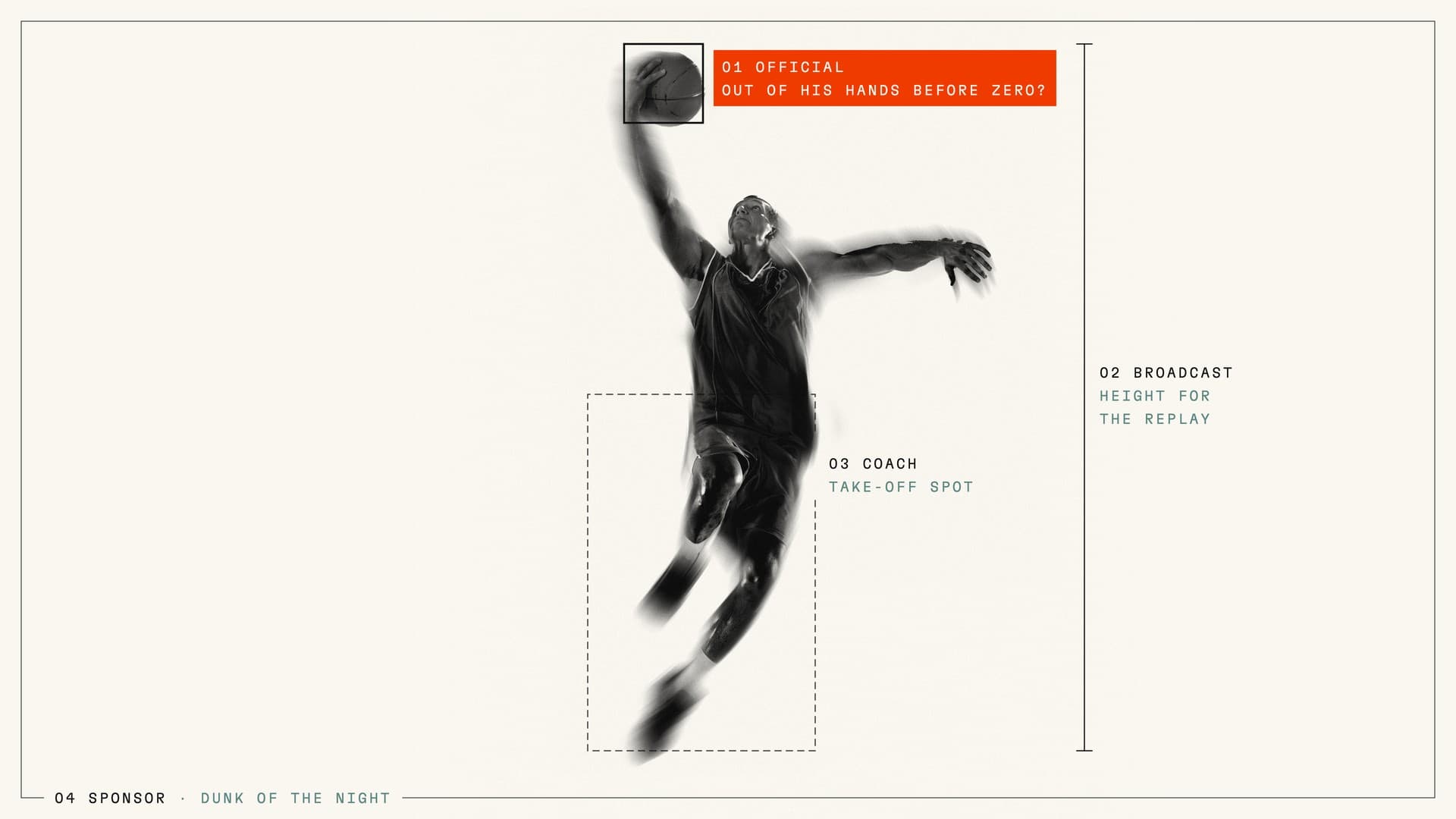
The same measurement that settles a line call can be used by everyone else working the event. Once a system can measure the action while the event is still live, broadcasters, athletes, coaches, and sponsors can use that data too. Officiating is where that work is tested first.
The same live data serves different people in different ways:
Officials:
evidence for a review, with the frames behind it
Broadcasters:
a replay or graphic that explains a close call while the event is still live
Athletes and coaches:
a performance measurement they can use in training or between rounds
Sponsors and rights holders:
a trigger tied to a specific moment in the event
That is the company we are building: live vision intelligence for sports. We are also building a platform that turns that intelligence into workflows for the people officiating, producing, competing in, and sponsoring an event, and we will share more about it soon. We introduced the underlying idea in Live Video Intelligence, Explained.
What Is a Live Sports Intelligence Model?
A live sports intelligence model is a computer vision system that measures motion, geometry, and timing in sport-specific context while an event is happening. It answers questions like where an athlete or object is, how it is moving, how that movement relates to lines, zones, or other players, and which rule applies at that moment.
OWL builds live vision and physics models for this, and they are powered by a world model we customize for each sport: a continuously updated representation of the live environment that tracks those relationships as they change. We judge it by what it can measure, how quickly it updates, and whether its output improves a real workflow.
The architecture matters as well. Some decisions need computation close to the action, so we are building for latency-sensitive measurement to run at the edge. Other tasks, like coordination across a whole event, run in the cloud with more context. The system also has to work across the camera and production setups we support, since no two events look the same.
We work with partners on general-purpose video-understanding models, and OWL's own work is the sport-specific layer around them: the models, measurements, integrations, and workflows that make video usable during the event.
Where Is Sports Technology Heading Next?
Sports technology is heading toward live intelligence that serves officiating, broadcast, performance, and sponsorship from the same capture. The largest companies in sports technology are combining optical tracking with athlete-performance data and fan experiences, and connecting live game data to broadcast graphics and advertising tied to live moments. Broadcasters and events are doing the same. Prime Video's Thursday Night Football coverage uses an AI model that tracks defenders before the snap and highlights likely blitzers on screen, and at Wimbledon in 2026, IBM's Key Moments feature used live match data to flag the plays shifting matches across all 18 courts.
Sponsors are also bringing technology into their rights-holder relationships, beyond traditional sponsorship. With that many companies working on overlapping strategies, the systems that last will be the ones with the best latency, deployment cost, model reuse across sports, integration, and results for customers.
What Should Leagues Ask Before Adopting AI Officiating?
Leagues weighing AI officiating should start with which calls are objective, how fast the evidence arrives, whether everyone can see what was measured, and who makes the final call. These are the six questions I would ask first, whether you run a major league, a growing tour, or a single competition:
Which of our calls are objective?
Start where there is a physical answer to measure, like a ball against a line, and leave judgment calls with officials.
How fast is the evidence, end to end?
Ask for latency measured from the moment of play to the official's screen.
Can everyone see what was measured?
Officials, players, and fans should be able to see the frames and the measurement behind a decision.
Does it work with the cameras and venues we have?
A system that only works at a flagship event will not scale across a season.
Who makes the call?
Your officials, every time, with the technology informing them.
What else can the same capture do?
If the same data can serve your broadcast, your athletes, and your sponsors, each deployment covers more of your operation.
Officiating is where we test our work hardest. Our broader goal at OWL is to make live sports intelligence practical across more sports and more events, and to build products on it for officials, broadcasters, athletes, and sponsors.
To see how OWL supports officials today, explore OWL Officiate or talk to the OWL team.
Frequently Asked Questions
What Is AI Officiating, and How Does It Work?
AI officiating uses cameras and computer vision models to measure objective moments in a game, such as whether a ball landed in or out or whether a pitch crossed the strike zone, and gives that evidence to officials. In most current systems, including MLB's ABS challenge system and Major League Pickleball's challenge system, officials still make the call, and the technology supplies evidence when a call is reviewed.
Will AI Replace Referees and Umpires?
League leaders describe a split: technology handles objective, measurable questions, and officials keep subjective calls like fouls. NBA Commissioner Adam Silver has described that split for out-of-bounds calls and fouls. At OWL, the principle is that OWL informs and officials decide.
How Often Are MLB ABS Challenges Overturned?
In the 2026 MLB regular season, players challenged 10,557 ball-strike calls and 5,686 were overturned, or 54%, according to MLB's ABS dashboard on Baseball Savant. That rate covers only challenged calls, which players pick because they think the umpire missed, so it is not a measure of overall umpire accuracy.
Which Sports Use AI Officiating Today?
Baseball uses automated ball-strike tracking for player challenges, football uses camera-based first-down measurement, and tennis and soccer have used electronic line calling and goal-line technology for years. Pro pickleball joined them in 2026, when Major League Pickleball used OWL for live line calls inside its challenge system. Basketball and hockey leaders have said automated calls on objective questions are coming.
About the author
Jay Prasad · Chief Executive Officer, OWL