Key Takeaways
Computer vision can count each sponsor's seconds on screen while a live broadcast or stream airs, on any feed you have live access to.
Sponsorship pacing compares those seconds with what each partner's target should have reached by that point in the event, so a shortfall shows up while there is still time to act on it.
A partner behind pace catches up only as fast as its new exposure outruns its commitment, which keeps accruing during the catch-up.
Rotation time on a digital board is shared, so pacing decisions are made across every partner on the board at once.
The live count is provisional, and the reviewed post-event report is still the figure sponsors and rights holders settle on.
Digital ad servers have paced campaigns for years, spreading impressions across a flight and speeding up delivery when a campaign falls behind. Sports sponsorship measurement has typically come after the event instead, in a report that arrives when the only remedies left are a make-good at a later event or a credit against the fee. Computer vision can now count each partner's seconds on screen while the event is still airing, so a rights holder can see a partner falling behind with time left to rebalance rotating inventory, where the partnership agreement allows it. OWL builds live vision intelligence for sports and opened the Parliament waitlist on October 21. Sponsorship pacing is one of Parliament's workflows, running on the same live feed as its moments, clips, and translation.
Quick Answer
To track sponsorship exposure in real time, run live logo tracking on the broadcast or stream. Computer vision counts each partner's seconds on screen as the event airs, and sponsorship pacing compares that count with what the partner's target should have reached by that point, so a shortfall shows up while there is still time to act. Treat the count as provisional, because it comes from one feed before anyone has reviewed the borderline detections, and settle on the post-event report. If the partnership agreement lets the rights holder rebalance rotating inventory such as LED boards, the live count shows which partner is behind, which partner on the board can spare time, and how long a rotation needs to close the gap. In OWL's Parliament platform, a pacing view puts every partner on one event clock and, when one falls behind, suggests which digital board to rotate it onto.
Why Does Sponsorship Exposure Reporting Take Weeks?
A post-event sponsorship report takes time because someone has to collect recordings of every feed the partner appeared on, run logo detection over them, and have people review the borderline cases, while audience figures firm up on their own schedules. Timelines vary by event and by agency.
Borderline cases include a blurred logo, a logo half hidden behind a player, or one on screen too briefly to count under the agreed methodology. Broadcast audience figures are firmed up after the event airs, and streaming and social figures arrive later still.
By the time the report lands, the event is over, so a shortfall is settled through make-good inventory at a later event, which the rights holder could otherwise have sold, or through a credit against the fee.
What Can You Measure While the Event Is Still Live?
While the event is on, computer vision can count how long each partner's logo appears on the feed being measured, record which board or graphic carried it, and compare the running total with the partner's target. Audience, value, and audited totals depend on data that arrives later.
During the event:
Seconds on screen. How long each partner's logo is detected in the feed. In Parliament, overlapping detections count once.
Placement. Which board, surface, or graphic carried the logo, so a team can see which inventory is delivering.
Pace. The seconds so far against what the target should have reached by this point in the event.
After the event:
Audience. How many people saw the logo, once broadcast, streaming, and social figures are in.
Value. What the agreed valuation method assigns to that exposure, and the starting point for a sponsorship ROI calculation.
Audited totals. The reviewed figures the sponsor and rights holder settle on.
Many measurement methods count weighted seconds, adjusting each second for the logo's size, position, clarity, and how many other logos share the screen, so a logo filling the frame counts for more than one in the corner of a wide shot. In a 2011 lab study of sports broadcasts, a logo's on-screen size and whether competing logos shared the screen both affected how often viewers identified the sponsor. Agree whether the live count and the final report use raw or weighted seconds before you compare them. A live broadcast count also leaves out exposure in highlights, clips, and athlete posts, which is usually measured separately and later.
How Does Real-Time Exposure Tracking Work, Step by Step?
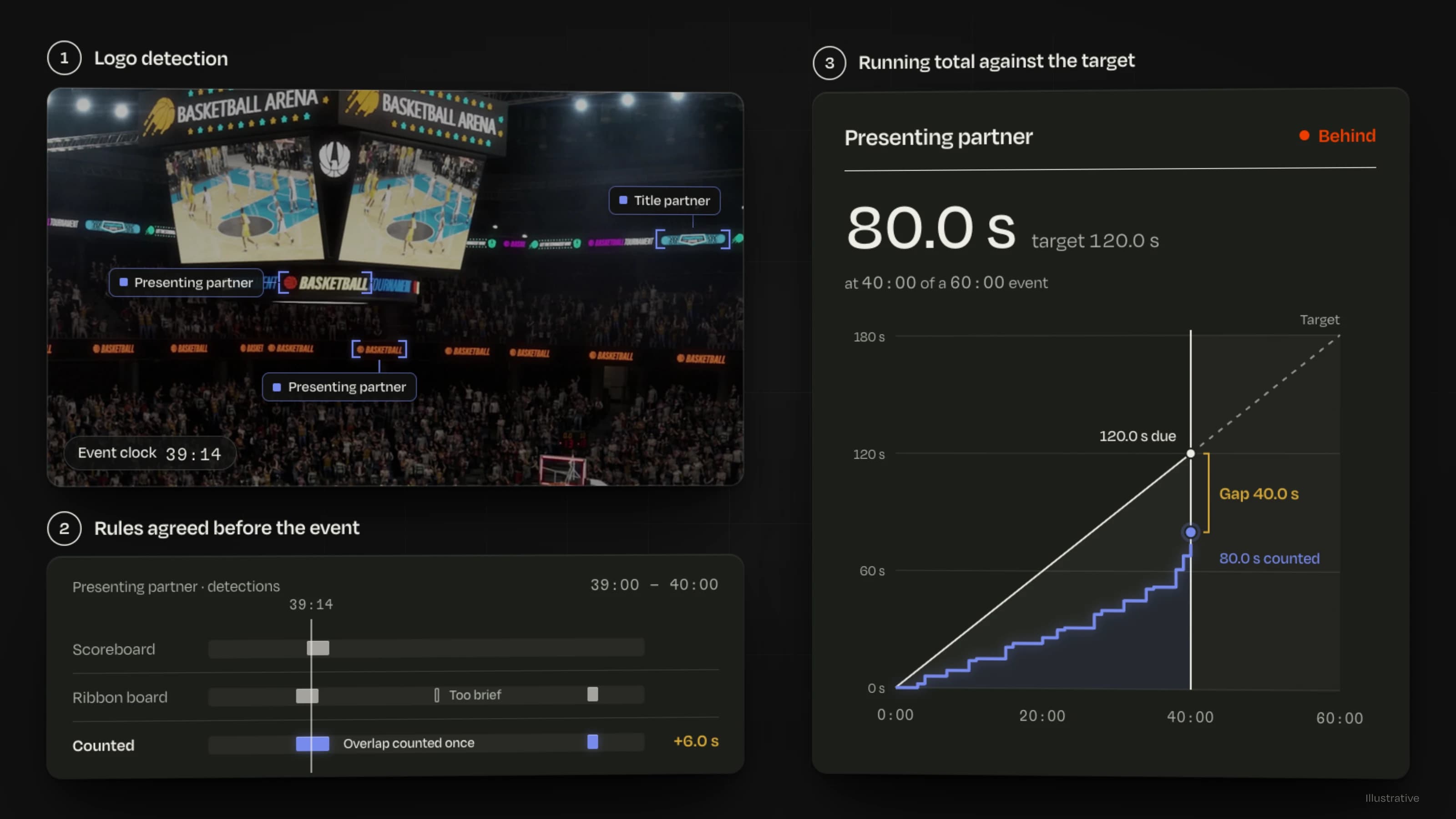
A live count has three parts. Logo detection samples the feed and marks where each partner's logo appears and for how long. Rules agreed before the event decide which detections count, and overlapping detections of the same logo count once. The kept detections add up to a running total of seconds for each partner, which is compared with the partner's target on the event clock.
Most of the work happens before the event, when the sponsor and rights holder agree on what counts, which feed is measured, how the target accrues, and who can act on a gap.
Agree on what counts as an exposure. Settle the minimum time on screen, the minimum logo size, how partly hidden logos are treated, what happens when several logos share the screen, and whether seconds are raw or weighted.
Choose the feed and secure access to it. The host broadcast, a domestic broadcast, a stream, and the venue's own feed don't always carry the same shots, and where virtual signage replaces boards by region they don't carry the same logos either. Name the feed the target applies to and get the rights holder's or broadcaster's permission to receive it live. The count works from that feed without extra cameras and runs on whatever delay the feed itself has.
Set the target and how it accrues. Commitments are usually written as event or season totals, in seconds, impressions, or value, and many partnerships commit to in-venue inventory such as a share of the LED loop rather than to broadcast seconds. To pace a total during the event, the two sides agree how to spread it across the clock, for example evenly by minute, period, or lap. Exposure arrives in bursts around scores, replays, and breaks, so expect a partner to move above and below pace.
Agree what can change mid-event, and who decides. Write down which boards can be rebalanced, which shots production could hold for a partner who is behind, who can ask for a change, who approves it, and how much notice production needs.
Watch every partner on the same clock and feed. Rotation time is shared, so extra time for one partner comes out of another partner's share.
Reconcile with the post-event report. Compare the live count with the reviewed figures, using the rules from step 1 and an agreed tolerance for the difference.
What's the Difference Between Tracking Exposure and Pacing It?
Tracking adds up the seconds a partner has received. Sponsorship pacing compares those seconds with what the partner's target should have reached at that point in the event, so a partnership manager can see during the event whether each partner is ahead, on pace, or behind.
At the 40-minute mark of a 60-minute event, a partnerships manager at a rights holder checks the live count. One partner's agreement targets three minutes on the host broadcast, spread evenly, so the target stands at two minutes. The count reads 1:20, which puts that partner 40 seconds behind with 20 minutes left. (All figures in this post are illustrative.)
How Does Sponsorship Pacing Work in a Formula 1 Broadcast?
Formula 1 has a global fan base of roughly 830 million, so on-screen exposure across a race broadcast is valuable to sponsors, and some have contractual commitments around how much of it they receive. Much of the measurement against those commitments has happened after the race.
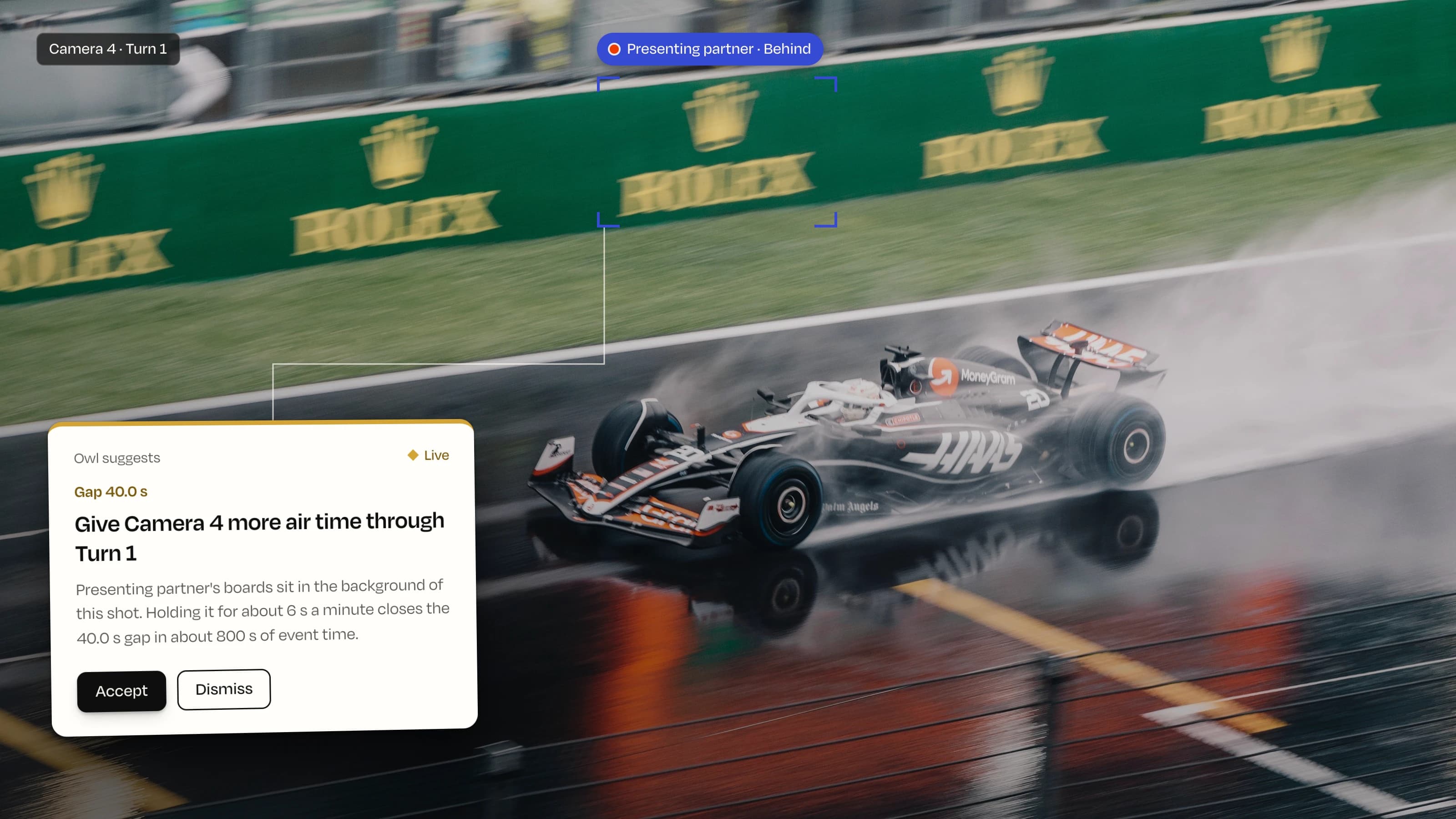
In Parliament, the pacing view counts each partner's airtime across the live race broadcast and shows how far each one is ahead of or behind its commitment, so a commercial team sees a shortfall during the race instead of in the report afterward.
Why Does Catching Up Take Longer Than the Gap?
A partner behind pace closes its gap more slowly than the size of the gap suggests, because its commitment keeps growing while it catches up. Take a partner owed three minutes over a 60-minute event, which accrues at three seconds a minute, and 40 seconds behind at the 40-minute mark. On a board the cameras show clearly for six seconds a minute, only the extra three seconds a minute go toward the gap, so the shortfall takes about 13 minutes to close. On a board the cameras show for three seconds a minute or less, the partner never catches up, however long the rotation runs.
As a formula, time to close (minutes) = gap in seconds ÷ (readable seconds a minute on the board − committed seconds a minute). Here, 40 ÷ (6 − 3) is about 13 minutes.
On a faster board, how much of the gap closes depends on how long the rotation runs, and a gap found late in the event may not close before the event ends. The same arithmetic applies to a fixed board, where the on-camera rate depends on which shots production holds.
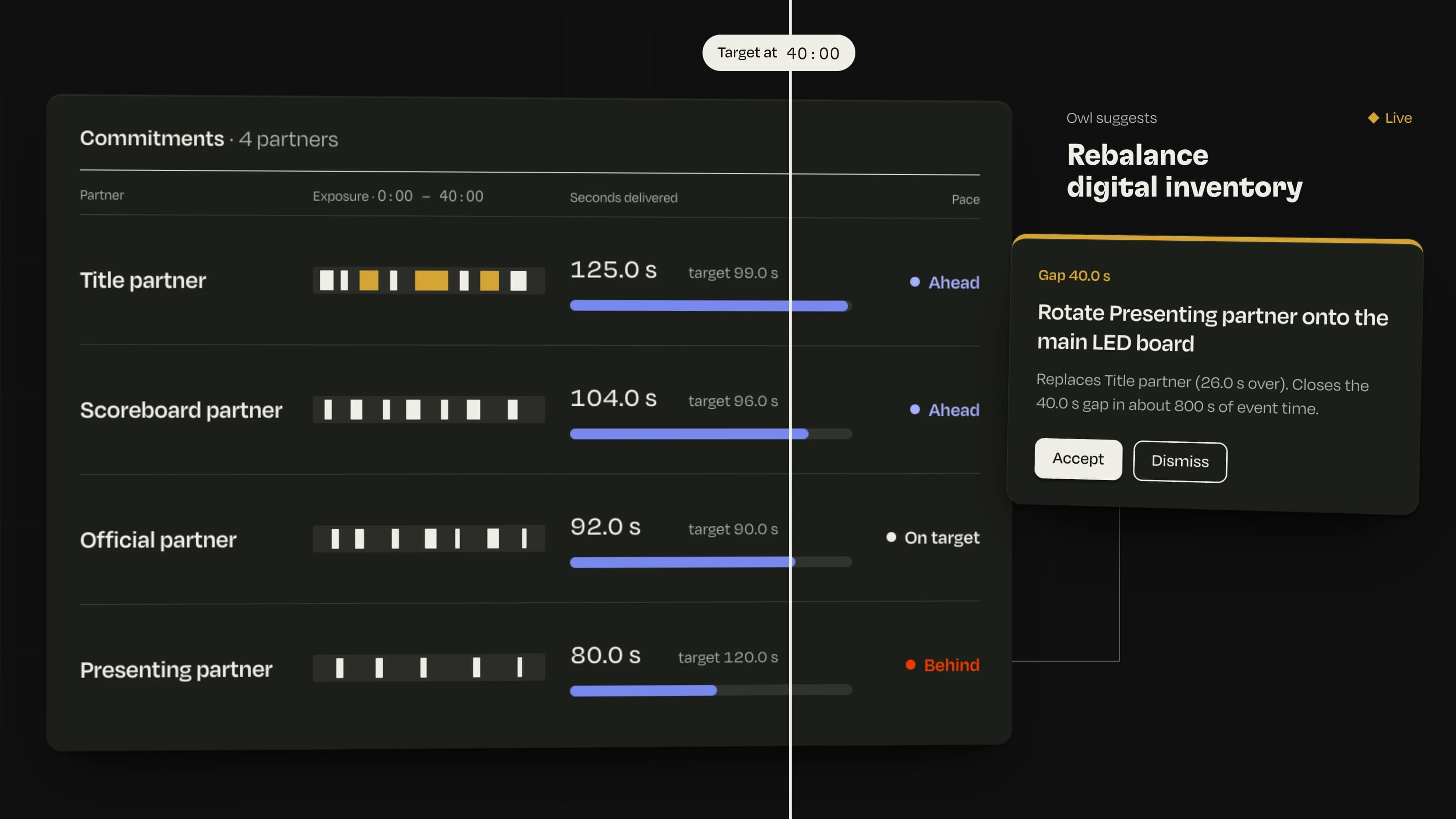
In Parliament, the pacing view puts every partner on one event clock and shows the seconds delivered so far against the commitment accrued so far. When it suggests a rotation, it estimates how much event time the rotation needs to close the gap, after allowing for the commitment that keeps accruing and for the share of a board's air time in which a logo is readable. If a board can slow the gap but not close it, the view says so instead of giving a time. OWL sets up the pacing view for each organization that asks for it, and our Ask Owl explainer shows where it sits in Parliament.
Why Is Sponsorship Pacing Decided Across Every Partner at Once?
Rotation time on an LED loop is fixed, so an extra rotation for one partner comes out of another partner's share. Say three partners share the main LED board at the 40-minute mark. Partner A is 40 seconds behind its target, Partner B is 30 seconds ahead, and Partner C is on pace. A per-partner report shows the same gain for A either way. Taking the slot from B narrows A's gap and leaves B near its target, while taking it from C puts C behind and opens a second gap.
Parliament's pacing view makes these suggestions across the whole board. It takes the partners furthest behind and suggests putting each one on a digital board whose current partner is ahead of pace, or on pace when no partner is ahead. Each suggestion is acknowledged or dismissed in the view, and gaps too small to be worth moving a board for aren't suggested.
What Can Actually Change When a Sponsor Falls Behind?
What can change during an event depends on who controls the inventory and what the partnership agreement says. LED rotation is usually scheduled before the event as a loop, with a set share for each partner, and the rights holder or venue runs it. In-feed graphics and virtual signage are run by the broadcaster or the host production, and so is the choice of shots. Rebalancing any of them mid-event needs sign-off from whoever controls it.
That leaves three situations:
The agreement allows in-event rebalancing. Production can give the partner who is behind extra rotations on a digital board for the rest of the event, within the limits other partners' contracts set.
The agreement doesn't allow it. The live gap tells both sides during the event that a make-good or credit is likely to come up afterward.
The placement is fixed. Jerseys, vehicle liveries, and painted signage can't change mid-event, though the shots production picks still decide how long they're on screen. Where production agrees, the live count could show the director which shot, such as a camera that keeps a partner's boards in the background, is worth holding a little longer.
How Reliable Is a Live Exposure Count?
A live count reflects one feed, and nobody has yet reviewed the borderline detections a post-event report would check. Its accuracy also depends on what the cameras show. Logo size, camera angle, motion blur, video compression, and players or equipment passing in front of a board all affect detection, and small logos on helmets, cars, and patches are hard for any detection system to read.
In a 2025 study of sponsor logos in Swedish elite soccer broadcast highlights, detection ran at about 20 frames per second on one cloud GPU, which the authors describe as suitable for near real-time dashboards. They also note that counting logos frame by frame, without following each logo from one frame to the next, leaves totals open to drift and flicker.
Use the live count to spot partners who are clearly ahead of or behind pace during the event, and use the reviewed report for settlement. After each event, compare the two and note which placements the live count struggled with, since those are the ones to watch at the next event.
6 Questions to Ask Before Tracking and Pacing Sponsorship Exposure in Real Time
Sponsors and agencies should settle these with the rights holder before the event:
What counts as an exposure? Minimum time, minimum size, partly hidden logos, shared screens, and raw or weighted seconds.
Which feed is measured, and do we have live access to it? The host broadcast, a domestic broadcast, a stream, or the venue feed, and whether virtual signage changes what each one shows.
What is the target, and how does it accrue during the event? On-screen seconds, impressions, or in-venue inventory, and how a total is spread across the clock.
What can change mid-event, by whom, and with how much notice? Name the boards that can be rebalanced and the shots production could hold, who asks, and who approves, and check what other partners' contracts allow.
What happens if a partner still finishes short? Make-good inventory, a credit, or a cure period, agreed before the event.
Can we see the count live and check it against the footage? Agree who has access during the event, how the data is exported, and which number settles a dispute.
To pilot real-time tracking, start with one event and two or three partners on rotating inventory, so the comparison is easy to read. Run the live count on the same feed the existing report uses, and keep the existing report as it is. Before the event, agree the pass criteria: how close the live count must land to the reviewed figures, whether live pacing flagged the partners who finished short, and whether each suggested rotation could have closed its gap at that board's rate.
Parliament is open by waitlist to rights holders and leagues, broadcasters and media companies, and sponsors and their agencies. Join the Parliament waitlist to hear when access opens for your team.
Frequently Asked Questions
How Is Sponsorship Exposure Valued?
Valuation starts from the seconds a logo was on screen, often weighted for size, position, clarity, and screen clutter. One common method multiplies the weighted seconds by the per-second cost of an equivalent broadcast ad, and the agreed method is applied after the event, once audience figures are in.
Can a Rights Holder Change a Sponsor's Exposure During the Event?
Sometimes. LED rotation is usually scheduled as a loop before the event, and changing it mid-event needs approval from the rights holder or production and room within other partners' contracted shares. Fixed placements such as jerseys and painted signage can't change, though the shots production chooses decide how long they stay on screen.
How Long Does It Take a Sponsor to Catch Up on Exposure?
It depends on how much faster the partner's new exposure arrives than its commitment accrues: time to close (minutes) = gap in seconds ÷ (readable seconds a minute on the board − committed seconds a minute). A partner 40 seconds behind, owed three seconds a minute and rotated onto a board that delivers six readable seconds a minute, closes the gap in about 13 minutes. If the board delivers no more than the partner's committed rate, the gap doesn't close.
Does OWL Change Signage or Ad Inventory Automatically?
No. Parliament doesn't control signage or ad inventory, so any change on the board is made by the rights holder's partnership and production teams. The pacing view suggests rotating a partner who is behind onto a digital board whose current partner is ahead, with the event time the rotation needs to close the gap.